
Sermon: Walking on God’s Love
A sermon based on Psalm 139
Although by any straightforward definition of a Christian I am a heretic, I nonetheless believe strongly in the importance of churches, even when I disagree with much of what many of those churches affirm. The churches provide not only community, ritual, and sacred space, they also educate, challenge, and support individuals in their life of faith. They are opportunities for regularity in our lives, something we can count on. One dimension of the Christian churches that I fully support is the lectionary cycle of scripture readings. Not only does this provide a way to move through much of the Bible in three years, but it also unites the churches in an important way. Every week, in every corner of the globe, churches small and large are reflecting on the same texts.
As an occasional, rather than regular, preacher, going to the lectionary to find out the scriptural options for a specific week brings a sense of both anticipation and dread. Anticipation because I get excited to learn what important text I will get to reflect on with a congregation, and dread because there are many texts that are just hard to preach on. The gospel text for this week is one of those latter texts. That is why no one read it today. It is from the gospel of Luke and is the one where Jesus says that “whoever does not hate father and mother, wife and children, brothers and sisters, yes, and even life itself, cannot be my disciple” (Luke 14:26). I so dislike this text that when I was asked to identify the scripture for this week I overrode my usual bias of ensuring that the gospel text is always read. I just think it is highly unlikely Jesus said these words, not because I don’t like them, but because they likely focus on a problem that was much more prevalent in pagan households than Jewish ones, and pagan Christians were not really a thing yet during the ministry of Jesus. For a pagan to join a Christian church, that pagan would be asked to foreswear the pagan gods that both his family and the wider community worshiped. They would be asked stop participating the public ritual worship of pagan gods. These Christians would be seen as disruptors of long and deeply held family commitments and of public life. That this requirement of Christian life would cause strife in a pagan household dividing members of the family from each other is not surprising. That this scripture shows up only in the most pro-pagan, that is pro-Gentile, gospel – the gospel of Luke – makes me even more suspicious that these words of Jesus were created to support pagan Christians living decades after Jesus and to help them think that the strife they were experiencing is all part of Jesus’s plan.
If the gospel reading left me frustrated, the Psalm for today left me delighted. 32 years and 2 days ago, sometime around 4:15 in the afternoon at Community Christian Church in North Canton, Ohio, today’s Psalm, Psalm 139, was read at my wedding. My wife and I don’t agree on a lot things, but both of us are what you might call God groupies, and there are few texts more appropriate for a God groupie than Psalm 139. The psalm makes clear a comprehensive, all-encompassing sense of God’s presence in the psalmist’s life. “Oh LORD, you have searched me and known me. You know when I sit down and when I rise up” (Ps 139:1-2). But the presence of God is not merely a matter of God knowing everything about the psalmist. I think many Christians have no problem thinking about God as a surveillance system. This is, after all, consistent with God understood as an oversized parent or judge. What many Christians have a much greater problem with is thinking that they are always in the presence of God and then acting accordingly. However, this is exactly what the psalmist is affirming. Already knowing that the answer is “nowhere,” the psalmist asks, “Where can I go from your spirit? Or where can I flee from your presence?” (139:7). Again, the answer to these questions is “nowhere.” There is nowhere that one can God where God is not already there. Perhaps some of you have heard me say that I do not need to die to be with God. God is already as much in every corner of the earth and of all creation as God is in whatever heaven would be. As I already noted, not only is this an unusual way for many Christians to think, most Christians that I know, even those who might assent to the idea of God’s ubiquitous presence at some intellectual level, have a very difficult time living their daily lives with this conviction about God’s presence in their minds and their hearts.
For example, I am frequently known to shout expletives at drivers who make my life difficult on the road. Of course, I do not do this to their faces, and they never hear me, but much to my youngest son’s bafflement, I gain considerable satisfaction from these outbursts. If I remembered that God is in the car with me, I would feel more foolish as the expletives streamed forth from my mouth. Let me be clear, God does not just know what I am saying, God is right next to me as I say it. If I could remain aware of God’s presence in the car a little more, I think I would be less likely to swear so much.
So, the task for us Christians is ramping up our awareness of God’s presence in our lives. Many Christians might say that they feel God’s presence in their prayer lives, and I have no interest in disputing that. However, most Christians spend most of their time doing things other than praying. How might they cultivate a greater awareness of God’s presence in every moment of their lives?
Over the last year, I have been doing a lot of reading in neuroscience. Three ideas from neuroscience might be helpful in building an awareness of God’s presence in our lives. First, our brains contain neurological reference frames that wire together to create world models. We remember things and we anticipate actions based on these reference frames. Second, and this part is genuinely bizarre, our brains have discovered that it is more efficient to project knowledge of the world rather than take it in. Using the reference frames and world models, our brain, especially our neocortex, the big wrinkly part on the outside of our brain, makes predictions about what is going on and presents those predictions to us. What this means is that we see the world not as it is, but as our brain predicts it to be. Our experience of the world is overwhelmingly based on controlled hallucinations. These hallucinations are “controlled” because the brain uses sense perception to make error-corrections and to update world models. I realize that claiming your experiences are controlled hallucinations is a bit much to take in, but I am happy to prove it to you at another time or to suggest some great books to read making this case.
However, what I want to move on to is the third important idea from neuroscience: hacking the brain. If our experience of the world is based on reference frames and world models developed in the brain, we change our experience not merely by doing different things, but by creating new reference frames and new world models. Let me give you quick example. Take a look at this picture:
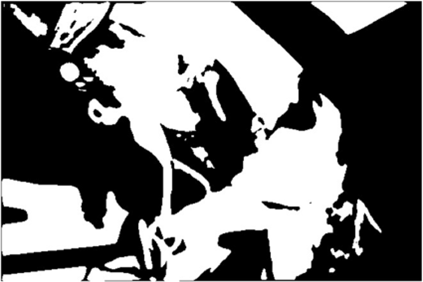
If you have never seen this picture before, it seems like a pure jumble of black and white blobs. But if I told you that it is a picture of a rider giving her horse a kiss, the blobs would immediately begin to cohere. This would be even more the case if I could have shown you the full-color picture that this image was based on, but I couldn’t figure out how to get an isolated copy of it to share. Now, here’s the really cool part. Once I tell you what the image is based on, once you see the original picture, you cannot unsee it. Your brain has now decided how that picture should look. You might think it is the same picture that you first saw, but your brain does not. Now your brain thinks it is a picture of a rider kissing her horse and it will never not be able to think that. Having been told what the picture is, your brain has been hacked. New reference frames were created that make it impossible for you to look at something the same way again.
Can we do the same thing for our understanding of God’s presence in the world? Can we hack our brains and create new reference frames so that what seemed like a world without God is suddenly a world filled with God? I think we might be able to, and I would like to suggest two brain hacks: 1) swimming in God; and 2) walking on God’s love.
In my younger years, I was an avid swimmer. I swam on swim teams for about 12 years, 5 of those involved year-round swimming. Being in the pool was a happy place for me. One of my favorite places was the diving area of the pool when they would close the diving boards and let swimmers just enjoy the deep water. I liked to get about halfway down, adjust the air in my lungs so that I would not go up or down, and then stretch my body out like Superman and pretend I was flying. A few little kicks would make propel me forward enough to make the sense of flying more real. This was especially fun if I could do it at night with the pool lights on. I was in a different world, just surrounded by water, and it somehow felt like home.
When I am outside, especially when I am just walking with nothing else on my mind, I imagine that I am swimming in God. The space around me does not feel empty, but more like the clear water of God’s presence. The sky does not seem to be just the sky, but rather a wall in a divine swimming pool. Don’t misunderstand me. This is not some mystical experience. I am too much of a spiritual neophyte to even imagine that I am experiencing something like what the great mystics of Christianity and other religions describe. Instead, it is for me something like a brain hack. Something where one idea – swimming in God – creates a new reference frame that automatically enables me to remember that there is no place I can go where God is not, something that helps me never to see the world as truly dull. After all, how can a world filled with God be a dull place? When I think that am I swimming with God, I do a better job of remembering that every move I make in that divine water is a gift that helps me to feel God’s presence. When you swim in pool, you feel the presence of the water pushing on your body and on your skin. When you swim with God, you feel God all around you.
There is a long tradition of seeing nature as a reflection of God’s grandeur. However, I don’t think the beauty or power of nature are reflections of God, since the idea of a reflection, like of the moon in the water, suggests that something is not really present. God is not reflected in creation, rather creation is held within God. I like the verb chosen by the poet Gerard Manley Hopkins. In his poem God’s Grandeur, he writes, “The world is charged with the grandeur of God.” Charged, like an electrical charge, implies a real presence, not just a reflection. If creation is such that God’s charge is present throughout, then the world is not just held by God, it is held within God. And within God we can swim; sometimes working hard to get our laps in and sometimes just floating, but always knowing that we never have to wonder where God is to be found. God is the water in which we swim.
My second brain hack is the idea of walking on God’s love. In Buddhist tradition there is a practice of walking meditation. Here the idea is not to clear your mind while walking, but rather to clear your mind by walking. By walking very deliberately, by paying attention to every muscle movement in the feet and the rest of the body, and by paying attention to everything that the feet encounter, one learns to slow the mind down and to free it from the countless distractions that keep it from seeing the world in its truest light. In Christian tradition, there are walking labyrinths that serve as both places for meditation, and as a symbolic expression of a person’s need to walk toward God. Both of these traditions are far more profound than anything I have in mind when I talk about walking on God’s love.
The idea of walking on God’s love is grounded on the notion of God holding the world in existence at every moment. My own understanding of the world involves something that I call nested order. Based on this understanding, all expressions of order, whether we are talking subatomic particles, human bodies, or big cities, all depend on the realities of order that came before them. Much like a topographical map with its nested blobs that get smaller and smaller signifying elevation, nested order reflects the fact that nothing exists all by itself. Everything depends on many foundational layers that had to come first. More importantly, the order on which things depend does not go away when new expressions order emerge but instead is persevered as it takes on new forms. Walking on God’s love works with the idea that God is the foundational layer for all of creation. As such, God can be said to “hold up” the world or hold the world together. But this foundational order is not merely the power of God, it is actually God. Thus, as new things emerge in creation, God does not go away, God transforms.
The idea of walking on God plays on this idea of holding up creation. The ground below my feet clearly holds me up, and in performing this simple task it reminds me of what God does at every moment. However, the walking is more than just a reminder of God. The ground on which I am walking is part of the nest of order that starts with God. I am thus not just walking on dirt, concrete, grass or asphalt, I am walking on God.
This foundational power on which I am walking is not just a power that keeps the world in existence, it is a power that we Christians characterize most fundamentally as love. When I am walking, therefore, I am not just walking on God’s power, I am walking on God’s love. I think this is an important distinction for the world at this moment in time. There are some people in governments right now in more than one country who are in love with power. But there is a big difference between being in love with power and the power of love (OK, some of you might just have heard a song by Huey Lewis start in your head. You can combat that earworm with a song by Katrina and the Waves when you think about Walking on God’s Love). When one is in love with power one is likely to worship things other than God. Perhaps one will worship money, race, or nation. Most often, I think people who are in love with power are just worshiping themselves.
Christianity has something different to offer: God’s love. We think this love is the most important love of all and that it can make a real difference not only in our own lives but in how we live together in the world. God’s love tells people that they are beautiful and wonderful just as they are. God’s love challenges each of us to be more loving in the world. God’s love demands that the laws and policies that leave so many people suffering from poverty and violence must be changed to bring an end to all poverty and violence. God’s love prods us to get off our butts and get moving with a commitment to such change. God’s love reminds us that those who disagree with us are also part of God’s creation and should never be demeaned, put down, or belittled, even when we really, really disagree with them.
Walking on God’s love is a brain hack. If we can learn to see something so simple and basic as the steps we take as reminders of what the world really is, a place where God is found everywhere, then we will never look at the world the same way again.
Here at Christian Temple, we try to pass God’s love along. We may not always succeed in doing so, but we are committed to trying. I hope you find God’s love in this place and in every moment of your life.